


Power on with eNpower® in dry seasons
Author: Rob Dwyer, Technical Agronomist – Tropical Systems, Incitec Pivot

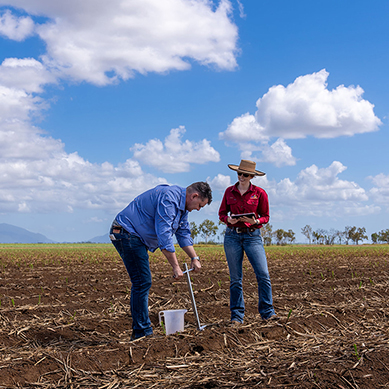
Image: Technical Agronomist for Tropical Systems, Rob Dwyer. Source: Incitec Pivot, 2025
This year, early ratoon growth in many cane growing districts has been slow due to a combination of dry conditions and cooler overnight temperatures, even in the much of north (with the exception of the Wet Tropics coast & fully irrigated Districts). This has put fertiliser programs behind schedule.
The dry weather has also meant that growers and their advisers have not been thinking about the risk of nitrogen losses from leaching, denitrification or runoff. This is a case of “out of sight, out of mind”. But actually, eNpower has a good record of success when applied in the dry. That’s because it doesn’t stay dry forever.
How long eNpower remains active in the soil depends on biological activity. When soils are dry, eNpower remains active for longer and even with warmer soil temperatures. This means eNpower is likely to still be actively inhibiting the nitrification of applied fertilisers even after a few months of
dry weather. This is particularly relevant this season, with the Bureau of Meteorology (as at 09/09/26) forecasting a dry September & October but ‘average’ or ‘wetter than average’ December & January.
Often, when there is a drier start and as especially the season progresses, the next rain event is more likely significant one. That’s when eNpower delivers good results for growers, because the nitrogen is stabilised as ammonium and available in the root zone for use when the crop starts growing. Under these conditions and with adequate soil cover, ammonium is much less likely to be lost compared to other nitrogen forms or untreated conventional urea blends. This can equate to both, better crop uptake of nitrogen & yield response.
For example, in a replicated small plot trial in the Herbert district in 2013/14, using eNpower increased cane and sugar yields over a traditional urea blend, even though it was dry for two months after the fertiliser application (Figure 1 and Table 1). It began raining on Boxing Day and then four months later, Cyclone Ita hit, providing another major deluge. At the end of the season, where 150 kg/ha of nitrogen was applied as an eNpower urea blend, 81.5 t/ha of cane was cut with a sugar yield of 11.2 t/ha. The same rate of nitrogen supplied as a urea blend yielded 53.7 t/ha of cane and a sugar yield of 8.4 t/ha. The losses from the untreated urea blend appear to have been so significant that even applying a higher rate of nitrogen did not improve yield.

Figure 1: eNpower urea provided higher yields despite a dry start to the season in 2013. Source: Herbert Sustainable Farming Systems group, the Queensland government and Herbert Cane Productivity Services Limited. Significant difference shown by letter at P<0.05.
Table 1: Sugar yield response (t/ha) from eNpower and urea blends, Herbert district, 2013/14
| Zero N | 110kg/ha of N as urea blend | 110kg/ha of N as eNpower urea blend | 150kg/ha N as urea blend | 150 kg/ha N as eNpower urea blend |
| 8.0 (a) | 8.8 (abc) | 11.8 (d) | 8.4 (ab) | 11.2 (d) * |
Source: Herbert Sustainable Farming Systems group, the Queensland government and Herbert Cane Productivity Services Limited. Significant difference shown by letter at P<0.05. Sugar yield was detrimentally influenced by lodging and the interaction of Cyclone Ita and wind resistance on the higher cane yield grown with eNpower performance up to the onset of this weather event.
It was a similar story after another dry start to the season in Innisfail in 2017/2018. In January 2018 there were a few moderate rainfall events. This was 42 days after the fertiliser was applied. However, it was much later (77 days after fertiliser application) that the first significant rainfall event occurred (170mm in February 2018).
Using an eNpower urea blend provided statistically significant increases in cane and sugar yields compared with an untreated urea blend, based on the Six Easy Steps nitrogen rate of 110 kg/ha (Figure 2 and Table 2). The eNpower treatment at 110 kg/ha of nitrogen yielded 72 t/ha of cane and 12.2 t/ha of sugar. The untreated urea blend at the same rate yielded 60 t/ha cane and 10.4 t/ha of sugar. eNpower was able to deliver yield increases of 20% (t/ha of cane) and 17% (t/ha of sugar) respectively.
Figure 2: eNpower urea outperformed urea at Innisfail in a dry season.

Source: Assessment of potential benefits of EEFs in sugarcane cropping systems by Wejin Wang et al, Queensland Department of Environment and Science. Significant difference shown by letter at P <0.05.
Table 2: Sugar yield response (t/ha) from eNpower and urea, Innisfail, 2017/18
| Zero N | 110kg/ha of N as urea blend | 110kg/ha of N as eNpower urea blend | 150kg/ha N as urea blend | 150 kg/ha N as eNpower urea blend |
| 9.0 (a) | 10.5 (abc) | 11.2 (bcd) | 10.4 (ab) | 12.2 (cd) |
Source: Assessment of potential benefits of EEFs in sugarcane cropping systems by Wejin Wang et al, Queensland Department of Environment and Science. Significant difference shown by letter at P <0.05.
eNpower is typically active across all the unpredictable seasonal conditions cane growers face. Where agricultural soils have a pH(w) of more than 4.51, nitrogen fertilisers are better protected from leaching, denitrification and runoff with eNpower. If the fertilisers are incorporated into the soil with 10 cm of compacted soil coverage, the nitrogen is also protected against volatilisation losses. Consider incorporation with a StoolZippa® as a means of more consistently achieving the required compacted soil cover. Managing volatilisation is the first step towards achieving the best potential from eNpower use and even with untreated conventional urea blends. Additionally, the StoolZippa can reduce losses of nitrogen from runoff.
For more information about using eNpower this season, contact Rob Dwyer on 0428 111 471 or email rob.dwyer@incitecpivot.com.au.
References
1 Dwyer R, “Understanding ENTEC in a sugar cane system” (2019) https://www.incitecpivotfertilisers.com.au/news-and-insights/ agronomic-insights/sugar/understanding-entec-in-a-sugar-canesystem.

Horticulture, Pasture, Sugar, Summer Crop
Understanding soil acidity and nutrient availability
Summer Crop, Winter Crop
EASY N: Enhanced nitrogen means better productivity this season
Horticulture, Pasture, Sugar, Summer Crop, Winter Crop
Spot on soil sampling
